.png?ext=.png)
In 2025, moisture was sporadic across Eastern Canada. Disease pressure was high in areas that saw ample to excessive rainfall. Across most of Eastern Canada, heavy rains came in the early season, impacting planting timing and hybrid choices. These conditions early, paired with high temperatures in the summer, set the stage for problematic diseases such as tar spot to creep in later in the season. With high input costs and lower corn prices, ROI on any application is particularly top of mind. Fungicide applications need to pay – so making every droplet count is crucial.
When all the disease triangle components are in place — the inoculum (disease spores), the host (the plant) and the right environment — disease will likely manifest. If we get hot and dry weather, the opportunity for disease usually decreases. Temperatures in the 20’s are great for growing crops but, unfortunately, also for disease pressure. Add extended wetness to the equation and the chances for disease increase. That’s why it’s important to apply a fungicide, particularly on your mid- to high response-to-fungicide (RTF) hybrids. You can curb disease risks with fungicides, even when costs are above average, by managing applications efficiently.
Get the Most Out of Mid- to High RTF Hybrids
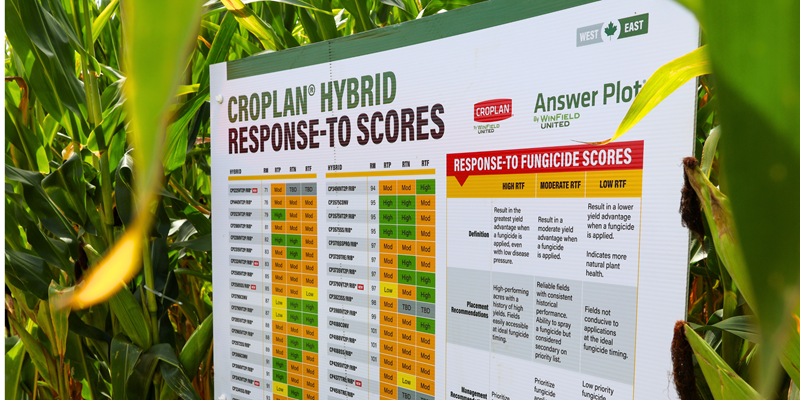
Late planting will cause corn plants to grow quickly. Anything you can do to keep them healthy and optimize biomass during the period of rapid growth up through grain fill is a plus. RTF scores are a valuable tool to help you with management decisions like these. This data, measured in randomized, replicated research trials through the Answer Plot® system, allows us to determine how a hybrid responds to a fungicide application.
Hybrids with high RTF scores respond greatly to a fungicide application, indicating you should prioritize those acres with your available fungicide dollars. Knowing your hybrids’ RTF scores enables you to make decisions now on which acres you’re likely to treat with a fungicide regardless of disease pressure and which acres, in the absence of disease, you probably won’t treat. You can view all CROPLAN® products’ RTF scores
in the 2026 seed guide here.
Maximize Impact with Every Application
Get more fungicide to the intended target by adding an adjuvant like MasterLock® to the tank. MasterLock is a non-ionic surfactant (NIS) with LockTech® drift and deposition aid. It works to deliver fungicides where they need to go by increasing canopy penetration and enhancing spray coverage, whether applied by ground or air. Additionally, the NIS component helps droplets stick and spread across the leaf surface, improving the area of contact for the fungicide to enter the leaf and reducing roll off or bounce. Data from Answer Plot trials showed hybrids sprayed with fungicide and MasterLock adjuvant yielded an average additional 5.7 bu/ac, compared to those sprayed with fungicide alone.1 In the US, data shows that when applied by drone, the tank mix with MasterLock delivered 6.2 times more spray into the canopy.2 While not a practice available for Canadian growers, this data further accents the deposition benefits MasterLock offers. With heavy disease pressures and high product costs, losing fungicide due to drift or evaporation is like throwing away your crop protection dollars.
Time Fungicide Applications Right
Consider spraying a fungicide on your mid- to high-RTF hybrids even in the absence of disease, because doing so can pay off in all yield environments. The sweet spot for spraying a fungicide on corn is VT to R1. However, if you’re a farmer who is growing high-RTF hybrids and don’t have access to an airplane or a helicopter, you can’t get a ground rig through the field at that growth stage. In this case, consider putting your ground rig through with a fungicide when your corn is between V10 – V14.
For more information on response-to fungicide scores and how to protect your high-value hybrids from disease for 2026, make sure to talk with your local CROPLAN seed expert.
1 WinField United. 14 studies, eight states, all fungicides. 2012-2017.
2 WinField United. Based on one trial, replicated three times, at the Innovation Center in River Falls, WI, in 2021.